
30 October 2026
PHP2Shell left PHP 8.1 unpatched. What that means for the software you are about to buy
Last week PHP shipped emergency fixes for two critical flaws affecting every release since 5.4. Only four branches got an official patch. For anyone buying, investing in or valuing a PHP codebase, the question is no longer "is it secure?" but "what will it cost to make it patchable again?"

Four branches patched. Everything else is on its own.
On 21 October 2026, the PHP project released emergency security updates for two vulnerabilities in the core interpreter, CVE-2026-109618 and CVE-2026-109619. Together they have been nicknamed PHP2Shell. Both are rated 9.2 on CVSS v4.0 and allow an unauthenticated attacker to execute code on the server, in default configurations.
The affected range is enormous: every PHP release from 5.4 through 8.5.11. The fixed range is not. Official patches shipped only for the four supported branches: 8.5.12, 8.4.27, 8.3.36 and 8.2.35. PHP 8.1 reached end of life in December 2025. Everything older had already been abandoned.
Workarounds will not save you either. Disabling session upload progress blunts one of the two attack paths, but does nothing against the other. The PHP team's own advice is blunt: there are no complete mitigations, and updating is the only safe choice. Within hours of disclosure, researchers were already reporting active exploitation attempts.
So if an application runs on PHP 8.1 or earlier, "apply the patch" is not an option. The patch is a migration.
An end-of-life runtime is a liability nobody has priced
Security teams will read PHP2Shell as an incident. Anyone valuing software should read it as a price signal.
When you buy a company, invest in it, or license its platform, you are paying for a codebase that has to keep running. A codebase pinned to an unsupported runtime carries a deferred cost that rarely appears in the data room: the migration it will eventually be forced into. PHP2Shell simply made that cost due.
Three things make it worth pricing explicitly:
- >It is rarely just the PHP version. An application stuck on PHP 7.x usually sits on an unsupported framework, frozen Composer dependencies and, sometimes, extensions that no longer exist. Upgrading the interpreter drags all of them along.
- >The clock keeps running. PHP 8.2 was patched on 21 October, but its security support ends on 31 December 2026. A team that migrates from 7.4 to 8.2 today will be back on an end-of-life runtime by the end of the year. A credible plan targets 8.4 or 8.5.
- >Not migrating also costs money. Extended-support vendors and some Linux distributions backport fixes to old branches. That is a legitimate bridge, but it is a recurring fee paid to stand still. It belongs in the cost model too.
None of this requires predicting a breach. A planned migration is a known cost. An emergency migration, done under exploitation pressure with no time to test, is the same work at a worse price. The gap between the two is the discount a buyer should be applying.
Putting a number on it: PrestaShop 1.6
To make this concrete, we ran Codeego on the public source code of PrestaShop 1.6, the open-source e-commerce platform whose official support ended in June 2019. It is a realistic stand-in for what turns up in due diligence: mature, feature-rich, still running in many European shops, and quietly frozen in time. We analysed the code, not any live store.
This is not bad software. It has a documented layered architecture, a coherent domain model and more than 75 localisation packs. Codeego values the engineering embedded in it at €1.80–2.44 million, roughly 19,000 hours of work. But its production readiness score is 42/100, and its own CI pipeline never tested anything newer than PHP 7.3.
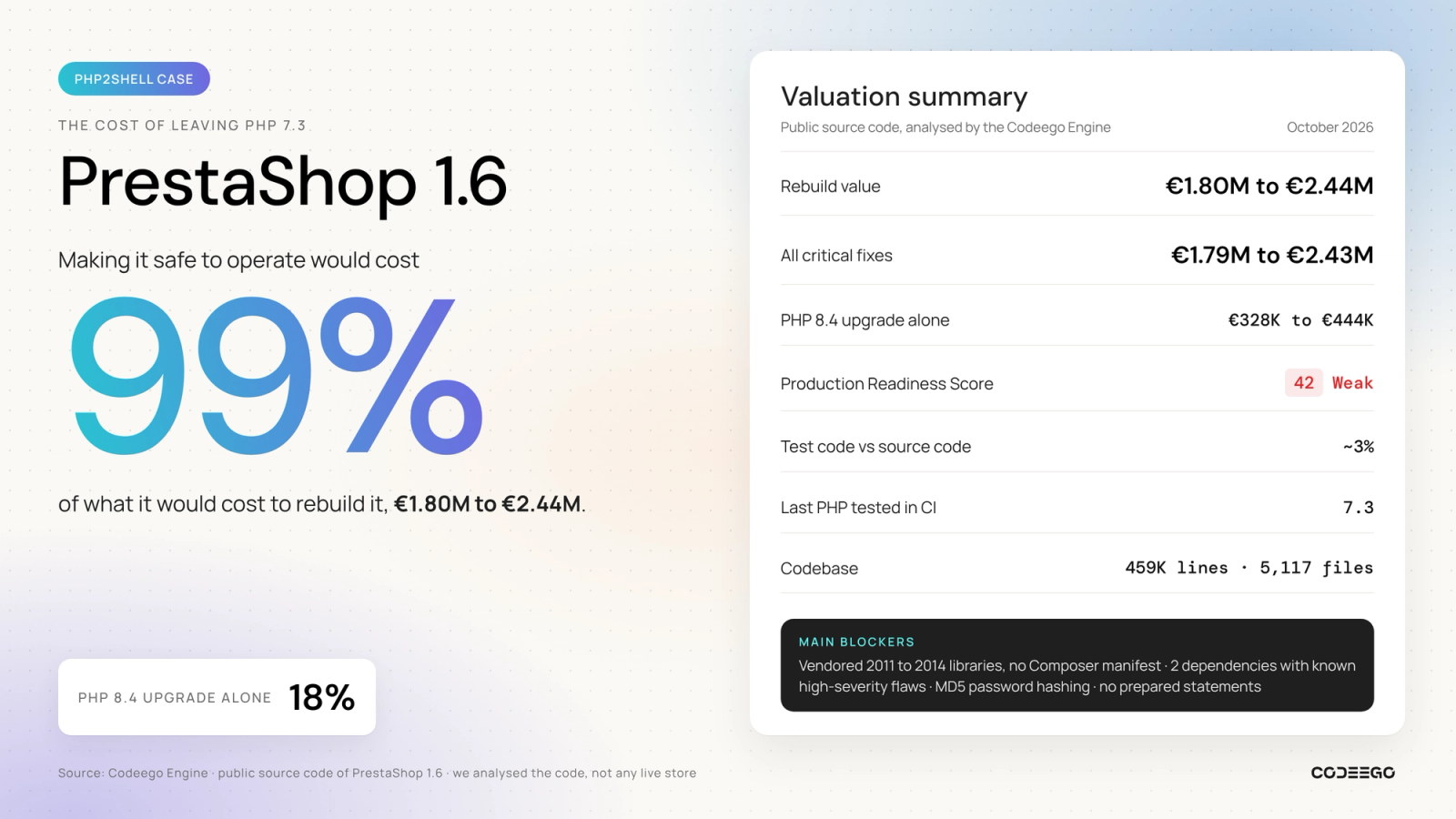
On its own, the runtime upgrade looks manageable: roughly 18% of what the codebase is worth. But that is not the real bill. With test coverage around 3%, nothing tells you whether the upgrade silently broke tax, shipping or order calculations. Building that safety net is the largest single item in the report.
Add it to the other critical fixes and the cost of making PrestaShop 1.6 safe to operate is almost exactly what it would cost to build it. That is the discount that was invisible on Monday and became urgent on Wednesday.
Five questions to add to your due diligence checklist
- Which runtime and framework versions does the product run on in production, and when does each one lose security support?
- If a critical vulnerability landed tomorrow, could the team ship the vendor's patch, or would it need a migration first?
- How many dependencies are pinned to versions that are no longer maintained?
- Is the company paying for extended support to avoid upgrading? How much, and until when?
- What would the migration cost, expressed as a share of what the codebase is worth?
The first four questions can be answered with a few commands and an honest engineering lead. The fifth is where most due diligence stops, because it turns a technical finding into a negotiating number.
Technical debt has a price. Now you can see it.
A Certified Software Valuation puts an independent, evidence-based number on a codebase: its replacement value, its Production Readiness Score, and how technical debt such as end-of-life runtimes and unmaintained dependencies erodes both. If a PHP codebase is part of your next deal, start a valuation before the next PHP2Shell sets the price for you.
Sources
Link the PHP advisory inline on first mention of the CVEs in the published post.
- >PHP project, security advisory for CVE-2026-109618 and CVE-2026-109619 (21 October 2026)
- >Help Net Security, PHP2Shell vulnerabilities patched (21 October 2026)
- >Recorded Future, PHP2Shell exploitation timeline
- >ComputingForGeeks, PHP2Shell check and patch guide (affected releases back to PHP 5.4, per the php2shell.com researchers)